
The Munsell color system is used worldwide!
Published Updated
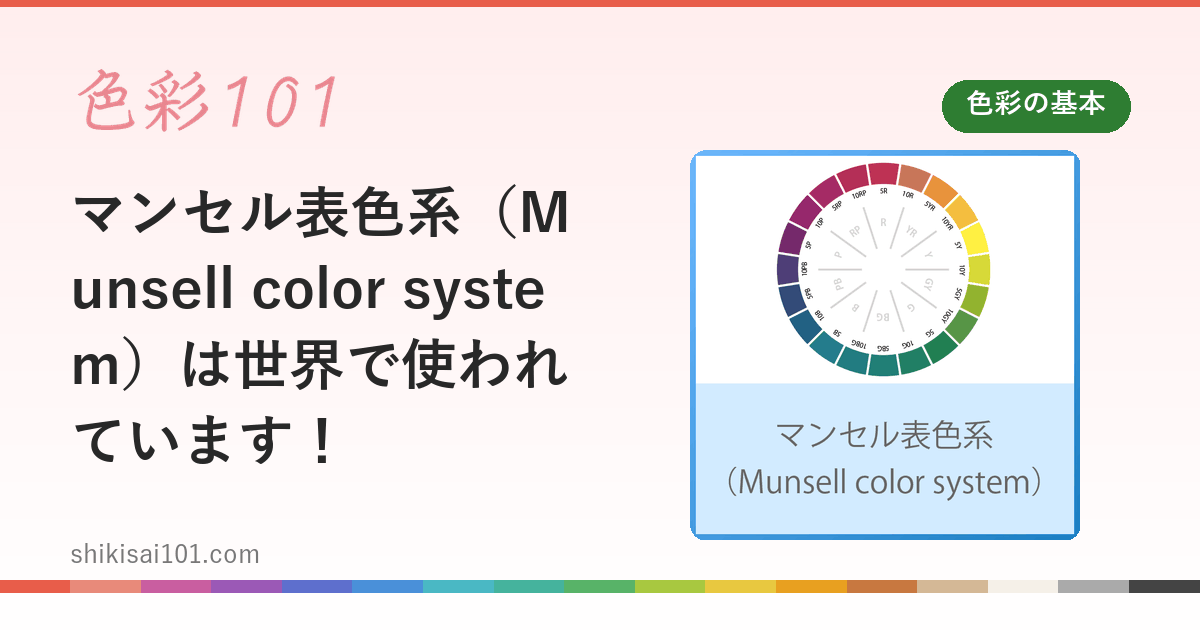
The Munsell Color System is based on a system originally devised by Munsell, an American painter and art educator, to systematically organize colors.
The American Optical Society (OSA) modified Munsell’s original system to ensure that all color differences are perceived as equally distinct, and this version remains in use today. This modified version is known as the “Modified Munsell Color System.”
Generally, when people refer to the Munsell Color System, they are referring to this “Modified Munsell Color System.”
Widely used around the world, the Munsell Color System is also used in Japan for color notation of conventional color names registered under JIS (Japanese Industrial Standards).
The American Optical Society (OSA) modified Munsell’s original system to ensure that all color differences are perceived as equally distinct, and this version remains in use today. This modified version is known as the “Modified Munsell Color System.”
Generally, when people refer to the Munsell Color System, they are referring to this “Modified Munsell Color System.”
Widely used around the world, the Munsell Color System is also used in Japan for color notation of conventional color names registered under JIS (Japanese Industrial Standards).
Hue
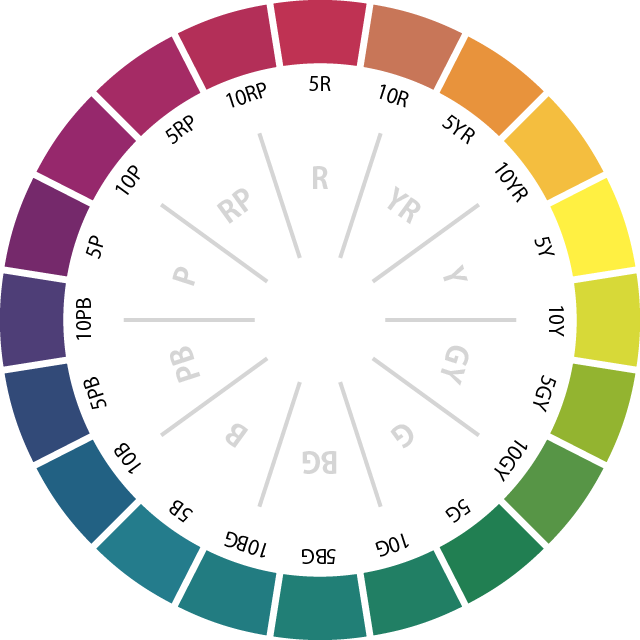
In the Munsell color system, hue is referred to as "Hue." This is the same as in PCCS.
The five basic colors selected by Munsell are R (Red), Y (Yellow), G (Green), B (Blue), and P (Purple).
As intermediate colors between these five, five additional colors—YR (Yellow Red), GY (Green Yellow), BG (Blue Green), PB (Purple Blue), and RP (Red Purple)—were added, resulting in a total of 10 colors.
Furthermore, by dividing each of these 10 colors into 10 equal parts, 100 hues are created.
In the Munsell color system, hue is denoted by a number representing the 10-equal division placed before the letter (e.g., "5R"), though this number is sometimes displayed with a decimal point (e.g., "7.5R").
This suggests a wide range of color expressions is possible.
Incidentally, it is said that people with normal color vision can distinguish between 1.875 million to 7.5 million colors, so the Munsell Color System is more suitable than PCCS as a standard for “color reproduction”—the process of creating colors.
Among the 10 equally divided hues, the color corresponding to number 5 (such as 5R or 5BP) becomes the representative hue denoted by that hue code.
Value
In the Munsell color system, lightness is referred to as “Value.” Although the terminology differs from PCCS, the system is based on a grayscale, just like PCCS.
The lightness of an ideal white, which reflects all light, is set to 10, while the lightness of an ideal black, which absorbs all light, is set to 0.
Although technology is advancing rapidly and efforts to create an ideal black are in full swing, it is not possible to produce a black with a Munsell value of 0 or a white with a value of 10.
In the Munsell color system’s color charts (color cards), the lightest color has a value of 9.5, and the darkest color has a value of 1.0.
The lightness of an ideal white, which reflects all light, is set to 10, while the lightness of an ideal black, which absorbs all light, is set to 0.
Although technology is advancing rapidly and efforts to create an ideal black are in full swing, it is not possible to produce a black with a Munsell value of 0 or a white with a value of 10.
In the Munsell color system’s color charts (color cards), the lightest color has a value of 9.5, and the darkest color has a value of 1.0.
Chroma
In the Munsell color system, saturation is referred to as "Chroma."
Like hue and value, it can be expressed as a decimal, with achromatic colors set to 0, indicating how far a color deviates from achromatic tones in terms of vividness.
Since the maximum chroma varies depending on the hue—as the range of colors that can actually be produced differs by hue—the maximum chroma value also differs by hue. This is a major difference from the PCCS system.
In the Munsell color system, the maximum chroma for 5R is 14, while for 5BG it is 8. Even with the same chroma value of 8, the perceived vividness differs depending on the hue.
Like hue and value, it can be expressed as a decimal, with achromatic colors set to 0, indicating how far a color deviates from achromatic tones in terms of vividness.
Since the maximum chroma varies depending on the hue—as the range of colors that can actually be produced differs by hue—the maximum chroma value also differs by hue. This is a major difference from the PCCS system.
In the Munsell color system, the maximum chroma for 5R is 14, while for 5BG it is 8. Even with the same chroma value of 8, the perceived vividness differs depending on the hue.
The Munsell Color System: A Tool for Color Reproduction
A key feature of this color system, created by Munsell—who was also a painter—is that hue, value, and chroma are set to represent actual existing colors as accurately as possible.
Since the structure of the eye varies from person to person, people rarely perceive the same color in exactly the same way.
When manufacturing industrial products—such as the colors of desks, walls, cups, slides, cash registers, shopping carts, and vehicles—the Munsell color system is extremely useful because it allows for precise color specifications.
Since the structure of the eye varies from person to person, people rarely perceive the same color in exactly the same way.
When manufacturing industrial products—such as the colors of desks, walls, cups, slides, cash registers, shopping carts, and vehicles—the Munsell color system is extremely useful because it allows for precise color specifications.