Why "An Unwaking Dream" Is the Color Purple
Published Updated
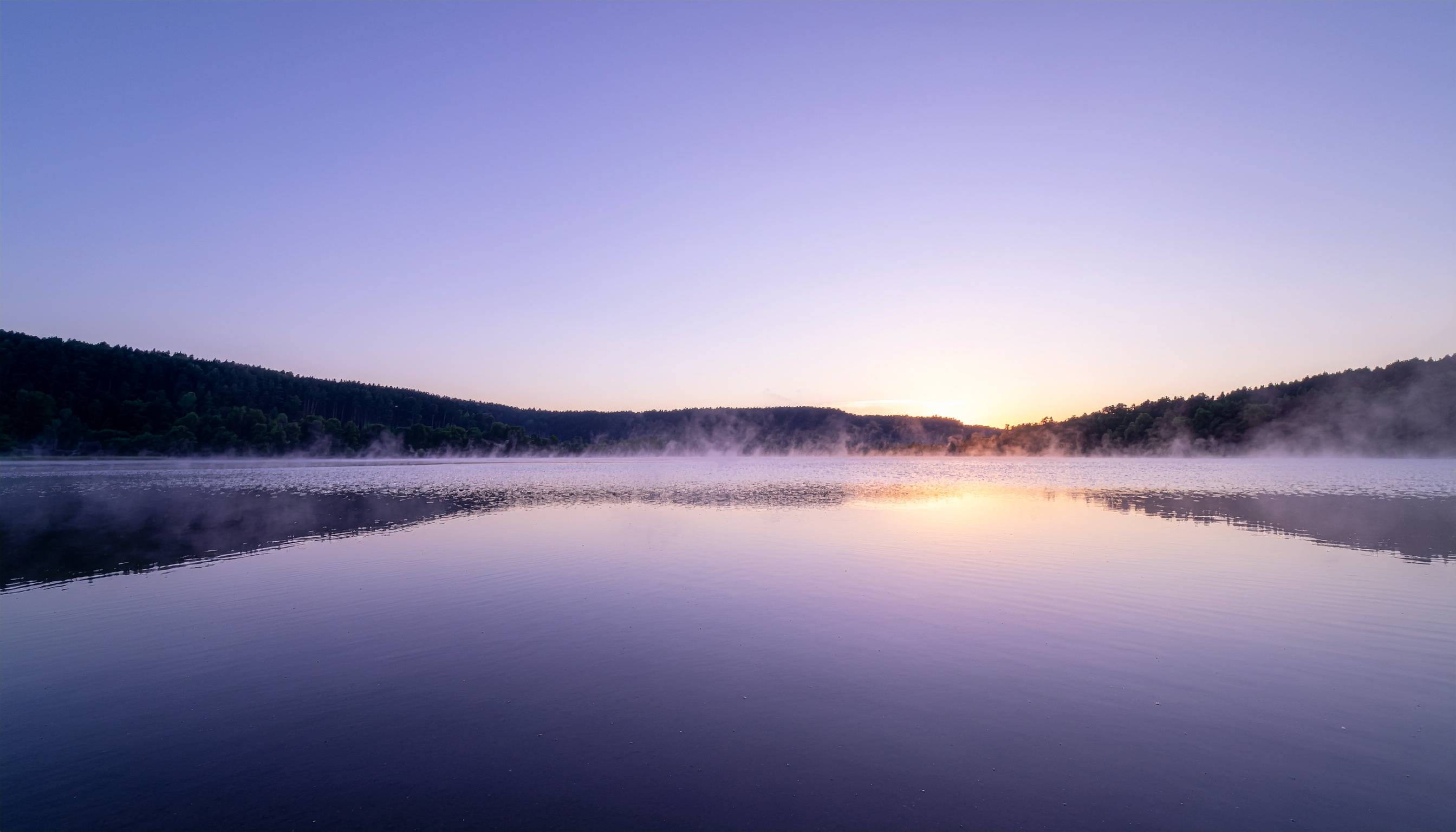
If someone said to you "an unwaking dream," what color would first come to mind?
Recently, in a small color survey conducted by shikisai101, more than 350 people answered this question. The top response was a clear winner by a wide margin.
Purple.
Deep purple, light purple, blue-violet, lavender, violet, wisteria, mauve, grayish purple — the expressions varied, but nearly forty percent of respondents chose some shade of "purple." Blues (blue, indigo, navy, ultramarine) came in second, followed by gray, black, white, and pink.
- Project: shikisai101 Color Mini-Survey (No. 46)
- Theme: "What color do you associate with 'an unwaking dream'?"
- Period: May 2026
- Platform: shikisai101.com (free-form web survey)
- Valid Responses: 357
- Format: Free-form entry of a color name and the reason for the choice
This article classifies and tallies the 357 responses by color family, extracts frequently appearing keywords from the free-form text, and examines them from a color-science perspective.
| Color Family | Responses | Percentage |
|---|---|---|
| Purple family (deep purple, light purple, blue-violet, lavender, violet, wisteria, mauve, etc.) | 138 | 38.7% |
| Blue to indigo family (blue, indigo, navy, ultramarine) | 79 | 22.1% |
| Gray family (light gray, dark gray, blue-gray) | 36 | 10.1% |
| Black | 29 | 8.1% |
| White / off-white | 24 | 6.7% |
| Pink / soft pastels | 22 | 6.2% |
| Other (red, brown, green, gold, rainbow, etc.) | 29 | 8.1% |
Within the "purple family," the most common answers were light purple and lavender (52), followed by blue-violet and violet (41), deep purple and mauve (28), and grayish purple (17).
What's especially interesting are the reasons people wrote down for choosing purple.
"A sense of the mysterious and the unknown"
"The borderline between reality and unreality"
"Romantic," "fleeting," "ambiguous," "mysterious"
"The color of the sky just before dawn"
So many similar words appeared that it feels like more than coincidence. In fact, of the 138 people who chose purple, 32 used some form of "boundary," "in-between," or "threshold" in their free-form answer; 41 used words in the "mysterious," "mystical," or "enigmatic" family; and 27 used "fleeting," "ambiguous," or "hazy"-type words.
Purple Is Always a Color of the "In-Between"
Purple has one defining characteristic: it can only be made by mixing red and blue, the two ends of the visible spectrum. Of the seven colors of the rainbow, purple is the only one that appears by bridging the two extremes.
Perhaps that's why, across times and cultures, purple has always stood in the "in-between."
In the sky between morning and night.
In the ceremonial robes between life and death.
In the drowsy spaces between waking and dreaming.
Just before dawn — those few minutes when the sky still rests at the bottom of blue, yet a faint red begins to seep in from the eastern edge. In Japan, this is called kawatare-doki ("who-is-that hour"), and in French, l'heure bleue ("the blue hour"). It may well be that the sky comes closest to purple precisely during this "time of the boundary."
One respondent wrote:
"The blue moment between night and morning. So beautiful it feels unreal. It reminds me of the boundary between reality and dream."
Those who chose purple may have been overlaying "an unwaking dream" onto this exact hour in their minds — that fleeting moment of twilight that is neither full darkness nor full waking, that cannot yet be named as either.
"Ambiguity" Is Drawn by Saturation
Let's bring in a color-science perspective here.
As the color for "an unwaking dream," people often chose not just purple, but expressions like "light purple," "muted purple," "lavender gray," and "blue ash gray" — blended descriptions that layer several color sensations together. This may not be a coincidence.
In fact, roughly 70% (97 of 138) of the purple responses were accompanied by modifiers that lower saturation by one step — words like "pale," "muted," "soft," or "grayish." Those who answered with a vivid, pure purple were actually in the minority.
Color has three attributes: hue, lightness, and saturation. Of these, the quality of "dreaminess" seems to be produced mainly by saturation.
When white or gray is mixed into a pure color, we get the tones that PCCS calls lt (light), ltg (light grayish), and g (grayish). Soft, hazy colors seem to suspend the brain's tendency to "make a verdict." That may be why people find it easier to project onto them things that have not yet happened, or that have not yet ended.
- Light purple (wisteria-leaning):
■ #B8A6D9 - Muted purple:
■ #8B7BA8 - Lavender gray:
■ #A9A2B8 - Blue-moment sky:
■ #5C5E8E
Each one is a purple turned down a notch in saturation — a purple that refuses to bring anything into sharp focus.
Some read purple as "a nightmare," others as "romantic." The same color can tip either way depending on the viewer's state of mind. This, too, may be why purple is called the "color of the boundary." Because it carries within itself both the passion of red and the stillness of blue, purple can show different faces at different moments.
Between Two Words: "Unwaking" and "Dream"
The second most common answer in this survey was the blue-to-indigo family (79 responses, 22.1%).
"The image of deep sleep." "The night sky." "The cosmos." "An endless sea."
These answers seem pulled toward the "unwaking" side of the phrase. Depth, distance, and inescapability — perhaps expressed through the coolness of blue.
Conversely, those who answered with pink, white, or soft pastels (46 responses, 12.9% combined) seemed to put their weight on the "dream" side.
"Because I felt it was a good dream I didn't want to wake from."
"The color of an atmosphere I want to drift through forever, like spring weather."
And those who chose purple may have folded both into a single word. Between "unwaking" (dark, closed) and "dream" (light, floating) — two opposing nuances pulling against each other — purple sits right at the midpoint.
Color sometimes visualizes not a single word, but the relationship between two words. The reason so many people chose purple may be that purple sits exactly at the resultant point where the vectors of "unwaking" and "dream" pull against each other.
Lingering Notes
When we think about color, we tend to isolate a single shade and ask, "What color is this?" But what may be truly interesting is the relational question — which word does this color sit next to?
Between "unwaking" and "dream," there was purple.
Between "before dawn" and "morning," there is purple too.
In moments when our hearts won't lean either way, perhaps we are quietly calling purple to us.
On Chromaterra, if you record just one color you felt each day, after a while you'll begin to see "the colors you unconsciously call to yourself." What kind of "in-between" is your heart in today?
References
- shikisai101 Color Mini-Survey No. 46, "What color do you associate with 'an unwaking dream'?" (Conducted May 2026, 357 valid responses)
- Chromaterra — Record the Color of Today
- Nippon Color & Design Research Institute, PCCS (Practical Color Co-ordinate System) tone classification