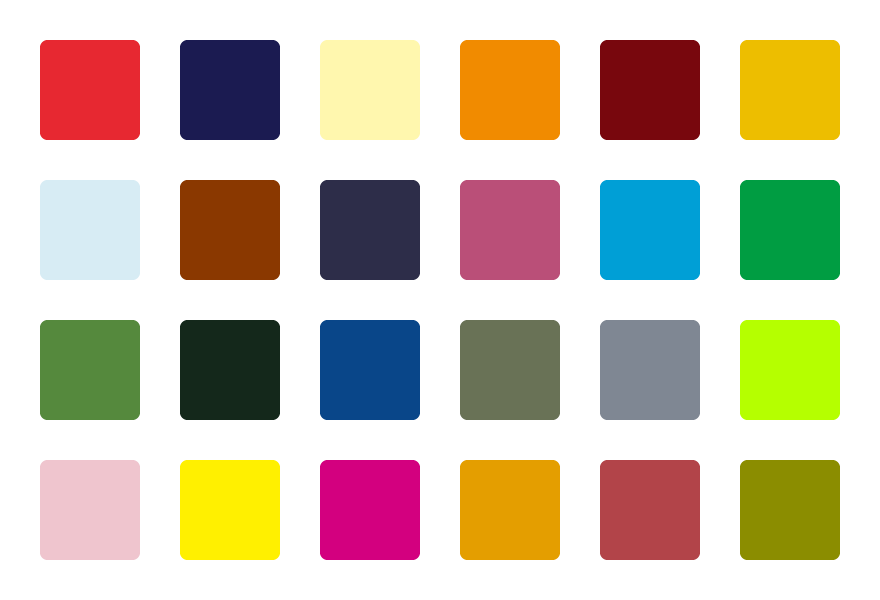
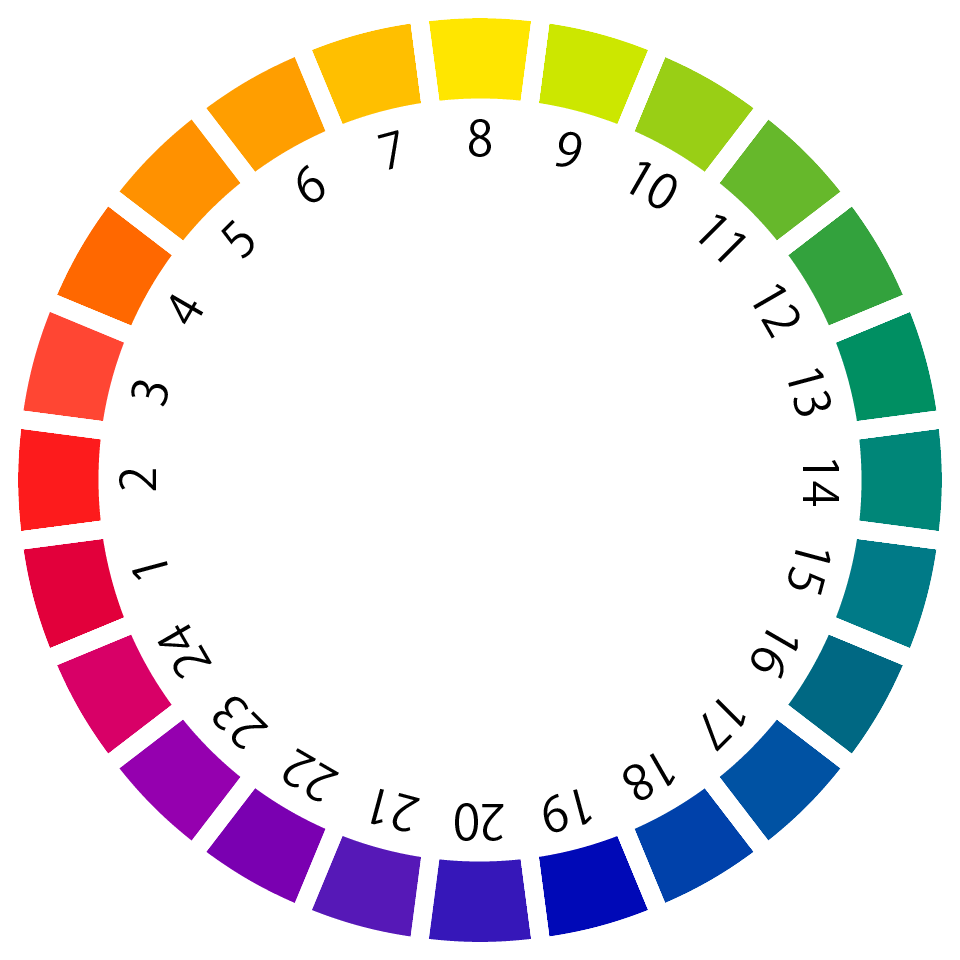
Below are a total of 24 color samples. Even similar colors can give a different impression if their hues differ slightly, and their names change as well.
How many of these 24 colors can you describe in words?
Out of these 24 colors, how many can be called "red"? How many can be called "pink"? How many can be called "green"? People have devised color names alongside the development of science and culture. However, the foundation remains unchanged—it is known as the three attributes of color.
Colors have various names and ways of being described—red, blue, yellow, yellow-green, green, pink, orange, gray, light blue, and so on—but isn’t it difficult to explain exactly what a color looks like to others?
For example, we sometimes use expressions based on personal perception, such as “the lightest blue” or “a shade of blue that’s a little brighter than the lightest blue.” Since color is an “ambiguous” concept that is perceived differently by each viewer, it requires careful consideration when communicating it to others.
To address this challenge, color science has evolved, leading to the development of the three attributes of color: hue, value, and saturation. By using these attributes, colors can be measured using three metrics and expressed through symbols or numerical values. This also makes it easier to categorize colors and add descriptive terms, such as “soft tones” (e.g., soft orange) or “vivid tones” (e.g., vivid red).
By having many people understand and utilize the three attributes of color as a common language, we can share “ambiguous” colors as accurately as possible.
Hue is easy to understand and expresses differences in shades such as red, orange, and yellow. However, value and saturation may feel somewhat difficult to grasp.
"Hue": Distinguishing Color Shades
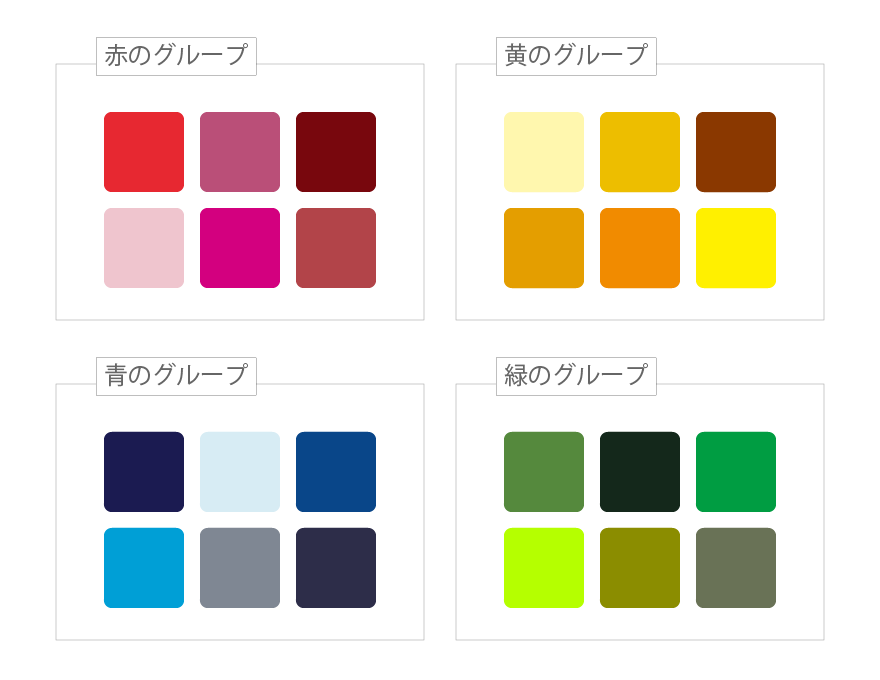
If we divide the 24 colors into four groups—red, yellow, green, and blue—it looks like this. Pink is included in the red group. Also, dark red resembles the dark yellow (orange) in the yellow group. Try naming the six colors in the blue group. Navy, sky blue, blue, cerulean blue, bluish gray, and indigo. Other color names are fine too.
Color is a visual sensation caused by differences in the wavelength of light, and depending on the range of those wavelengths, countless colors exist, including red, orange, yellow, green, blue, and purple.
Hue refers to these differences in color.
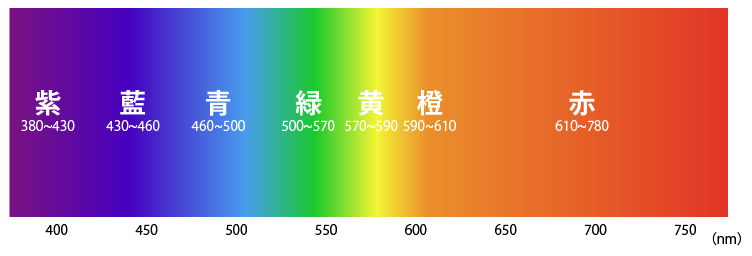
<The Light Spectrum>
Light is a type of electromagnetic wave and has a wavelength. It is said that humans can perceive colors in the range of approximately 380 nm to 780 nm, but even within this range, the colors we perceive differ depending on the wavelength. It’s a mysterious world of biological and ocular structure. Why did we evolve the ability to perceive color?
*The numbers represent the wavelength of light (unit: nanometers). The wavelength ranges listed for each color are standard values.
The light spectrum refers to the broad, band-like spectrum of colors that results when white light is dispersed using a prism or mirror, separating light of different wavelengths.
White light is a mixture of light of various wavelengths and contains electromagnetic waves across a wide range of wavelengths, from ultraviolet to infrared. When this light is dispersed using a prism or mirror, a banded light spectrum of violet, blue, green, yellow, orange, and red is produced. Within this spectrum, light with shorter wavelengths appears closer to violet, while light with longer wavelengths appears closer to red.
"Luminance": A Measure of Color Brightness
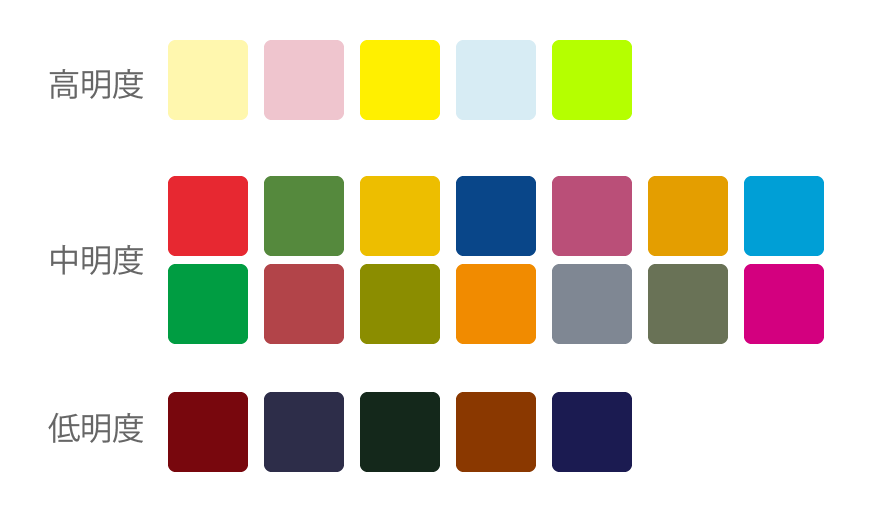
If we divide 24 colors into three groups based on value, the result looks like this. It is easy to see that the medium-value group includes colors with low, medium, and high saturation, but you can also perceive differences in saturation within the high-value and low-value groups. For example, a color close to ivory (high value) and a color close to canary yellow (high value) differ significantly in saturation.
Each hue has colors that are closer to white and colors that are closer to black.
Colors closer to white are called "light colors," and colors closer to black are called "dark colors"; this difference is referred to as "value."
For example, in the case of red, as the value increases (i.e., it becomes closer to white), it turns pink; as the value decreases (i.e., it becomes closer to black), it becomes a dark red such as maroon (a red close to black).
"Saturation": A Measure of a Color's Vividness
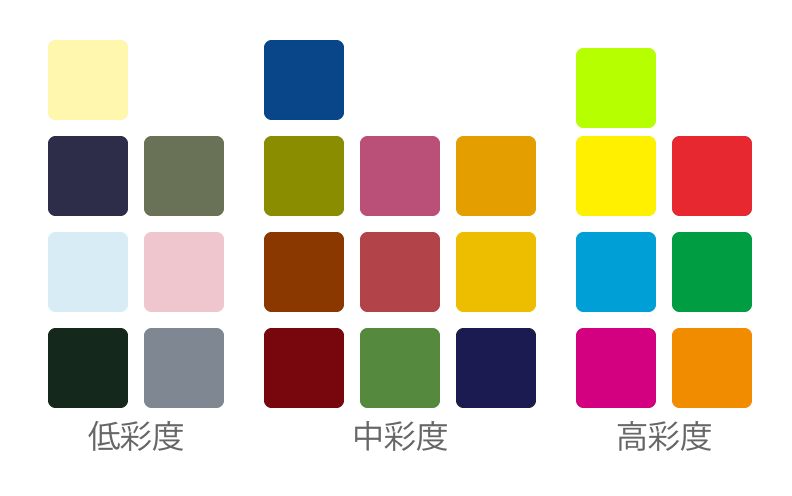
If we divide the 24 colors into three groups based on saturation, the differences in relation to value become clear. The low-saturation group includes high-value colors (colors close to white) and low-value colors (colors close to black). The medium-saturation group consists of colors that tend to feel gentle and soothing. The high-saturation group includes both high-value and medium-value colors.
The final of the three color attributes is "saturation."
Saturation refers to the vividness of a color; low saturation means the color is not vivid.
There is a term called "achromatic colors." These refer to white, gray, and black—colors without hue, meaning colors with a saturation of 0 (zero).
Low saturation means colors that are close to white, gray, or black. If a color has very low saturation and is light, it is close to white; if it has very low saturation and is dark, it is close to black.
High-saturation colors are what we call “vivid colors.”
In color theory, these are often referred to as “vivid” colors.
These are reds, blues, and yellows with excellent color rendering; in Japanese, we often describe them as “bright red” or “bright blue,” don’t we?
A red with both very high saturation and very high lightness may not actually exist. I say “may not” because it is difficult for humans to perceive such a color. Generally, as saturation increases, the number of hues with high or low lightness decreases. (For details, please refer to PCCS, etc.
)
The Difference Between Value and Saturation
It takes a little practice to intuitively grasp the difference between lightness and saturation. Please see the page below for a more detailed explanation of the differences between lightness and saturation.
PCCS: A Clear Guide to the Three Attributes of Color
A systematic classification of the three attributes of color is called a color system. In Japan, PCCS is used in a wide variety of contexts, including fashion color coordination, interior color coordination, exterior design (house exteriors and architectural design), web design, DTP design (printed materials such as flyers, business cards, and thank-you notes), and business document design.
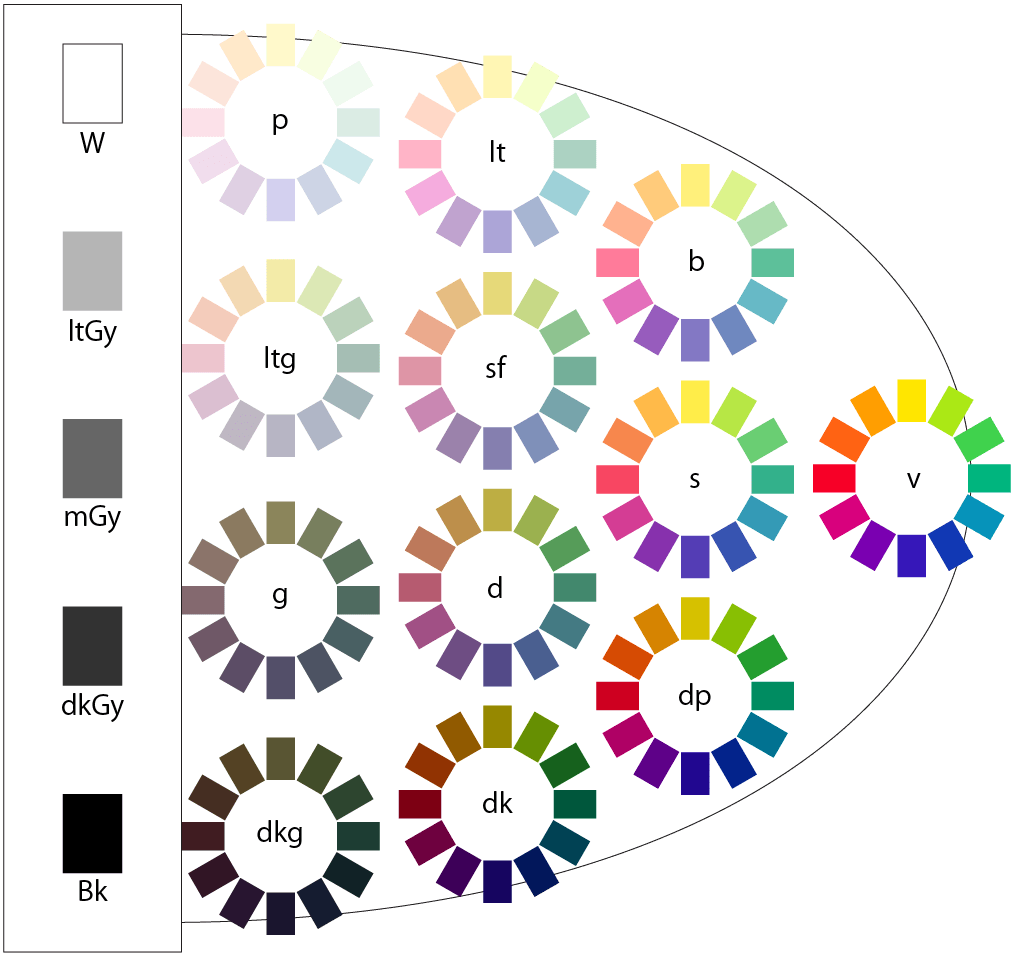
The PCCS color system consists of 24 hues. While you may often see diagrams featuring 12 colors, such as tone concept charts, the system officially comprises 24 hues, each with its own designated name.PCCS is based on 12 tones grouped by value and saturation. Each tone represents a group of colors with similar characteristics; for example, the "v" (Vivid Tone) group consists of colors that evoke images of being "vivid," "bright," or "eye-catching."
Having a standard for hue, value, and saturation makes it easier to combine colors. Since this is the most fundamental classification when learning about color, please be sure to remember it.
Online Practice Questions
You can view questions related to the "Three Attributes of Color" from the Color Certification® practice workbooks provided on this site below.