The Green Quiz: 5 Questions on Green Feathers, Dollar Bills & the Roots of "Midori"
Published
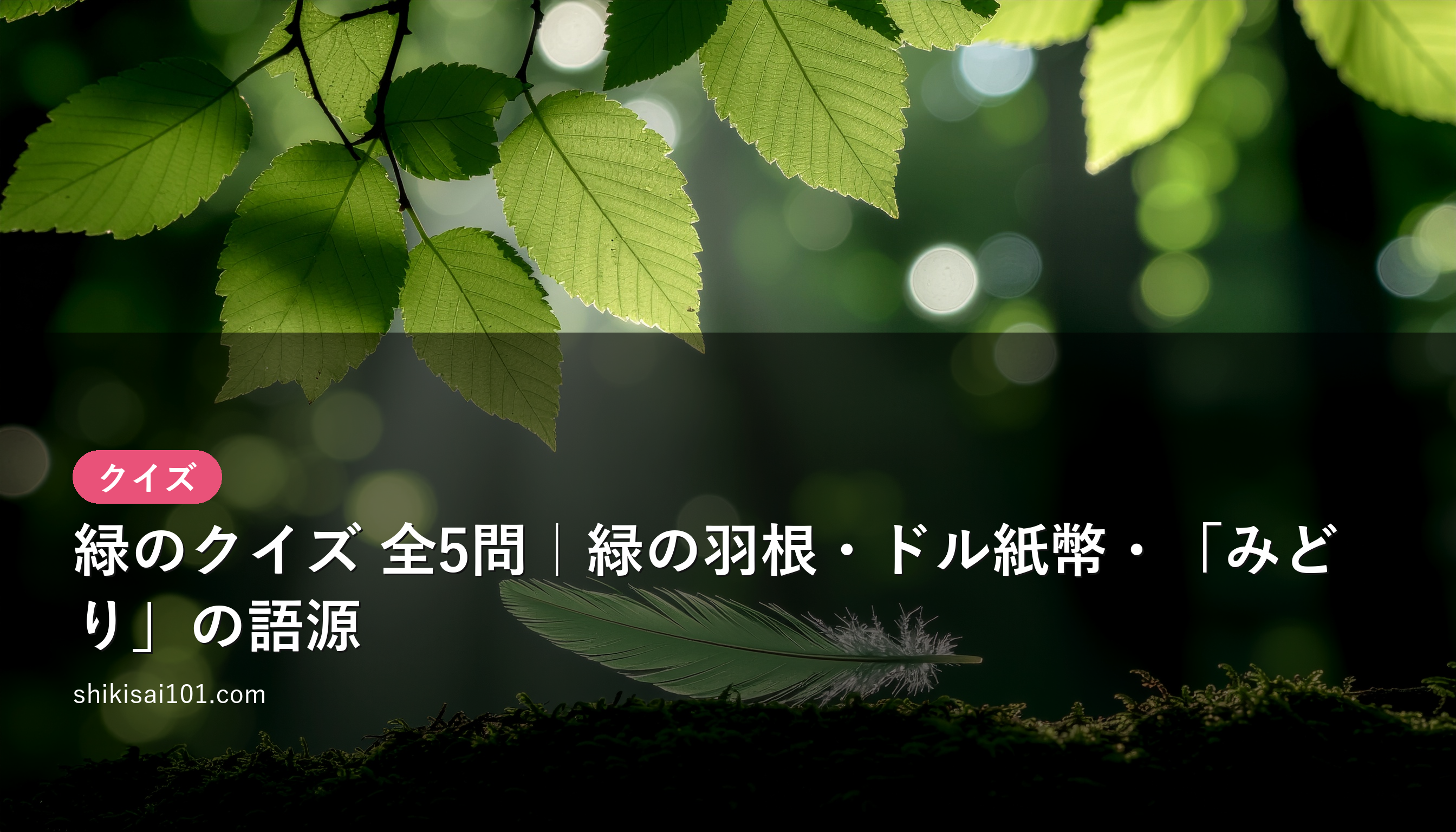
Green feels familiar, yet much about it is surprisingly little known. From a charity feather to banknotes that travel the world, to the roots of a Japanese word—once you know the answers, the greens around you start to look a little different. Five questions in all. How many can you get right?
Q1. In Japan, a "green feather" is handed out each spring for a charity drive. What is the money mainly used for?
- A. Building eco-friendly public transport
- B. Growing forests and greening the land
- C. Protecting endangered species
- D. Cleaning up urban parks
See the answer
Correct answer: B (Growing forests and greening the land)
The "green feather" is distributed during Japan's Green Week and similar events, and the money collected becomes a fund for the "national afforestation movement"—growing forests and covering worn-down land in green. If you look past the feather itself to its real purpose—"turning the mountains green"—the color and the action link up beautifully.
Q2. The French heraldist Michel Pastoureau described green as the color that evokes a certain emotion. Which one?
- A. Anger
- B. Jealousy
- C. Hope
- D. Reassurance
See the answer
Correct answer: C (Hope)
Pastoureau describes green as the color that "evokes hopes fulfilled or hopes dashed." It is the color of new buds, but also the color of expectations that never came true—which is exactly why green has long been talked about as a "wavering" color.
Pastoureau is a scholar who traced green through history as an "unstable, elusive color." The fact that green has carried opposite meanings—from the "go" of a traffic light to the symbol of jealousy—stems from this very instability.
Q3. Why did the US dollar bill come to be called a "greenback"?
- A. Because the issuing bank was named "Green"
- B. Because the back of the bill was printed in green ink
- C. Because green symbolizes the freedom and equality of the national flag
- D. Because it was issued to commemorate forest conservation
See the answer
Correct answer: B (The back was printed in green ink)
The "back" refers, quite literally, to the reverse side of the bill. The nickname was born from printing that side entirely in green. Cameras of the era could only shoot in black and white, and green ink was hard to reproduce—so it doubled as an anti-counterfeiting measure. The fact that the design has barely changed in nearly 200 years is proof of the trust it has earned in circulation around the world.
It is no accident that so many banknotes in countries influenced by Europe feature green. Beyond the durability of green ink and its resistance to forgery, the impressions of "trust" and "stability" that green carries were a natural fit for money as a tool.
Q4. The Japanese word "midori." What did it originally refer to?
- A. The darkness of a deep forest
- B. Fresh young plants, such as new shoots and young branches
- C. The color of the sea
- D. Old, moss-covered rocks
See the answer
Correct answer: B (Fresh young plants, such as new shoots and young branches)
Originally, "midori" was less a color name than a word for "new shoots" and "young branches," and it is said to be related to the sense of being fresh and full of moisture (mizumizushii). The fact that a baby is called a midorigo (infant) is said to be a remnant of this "young and full of life" meaning. Before it was ever a color, green may have been a word for the vigor of life itself.
Q5. Though also read "midori," how do the characters 碧 (aoi) and 翠 (sui) differ from ordinary green?
- A. A greener that leans more toward yellow
- B. A green that is more tinged with blue
- C. A darker, more subdued green
- D. No difference at all—they are exactly the same
See the answer
Correct answer: B (A green more tinged with blue)
Both 碧 and 翠 can be read "midori," but each refers to a green that leans toward blue. Being closer to blue, they give a cooler, fresher impression. Incidentally, the JIS standard color name "green" (■ #3baf75) is, surprisingly, not on the blue side at all—it sits at 2.5G, slightly toward yellow from a pure 5G. Even within "green," whether it tilts toward blue or yellow completely changes its character.
Placing a bluish green next to a yellowish green makes the difference clear. - Blue-leaning green (the impression of 碧・翠): ■ #009e96 - JIS standard color name "green" (slightly yellow): ■ #3baf75 - Yellow-leaning young-grass green: ■ #bbd347
References & Sources
- Michel Pastoureau, Green: The History of a Color (Vert : Histoire d’une couleur)
- National Land Afforestation Promotion Organization, "The Green Fund (Green Feather)" green.or.jp
- The origin of the US dollar "greenback" and the historical background of green ink (general materials from the US Department of the Treasury and on currency minting)